British Values
At Park End Primary, we recognise the importance of preparing children for life in modern Britain and promoting values that are an integral part of 21st century British society.
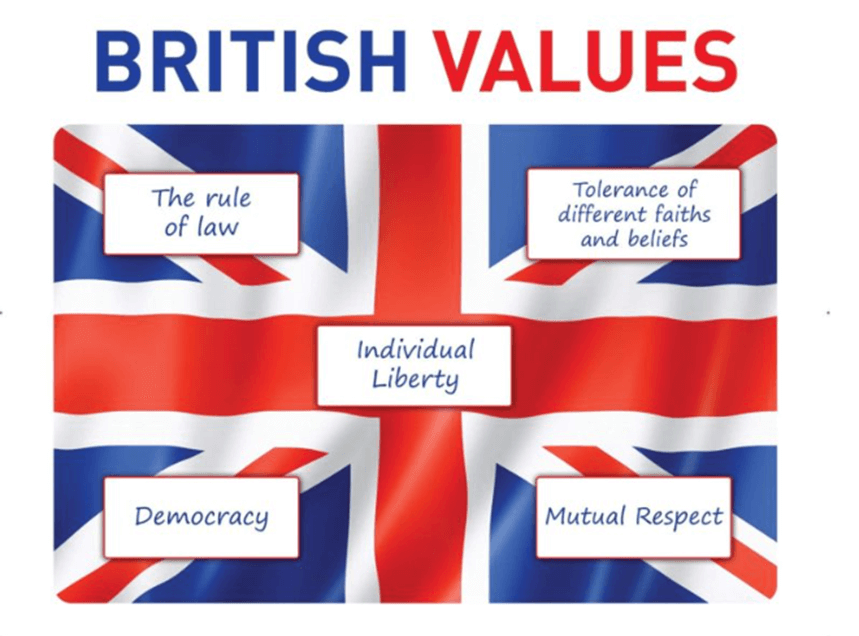
The Key Values are:
- Democracy
- Rule of Law
- Individual Liberty
- Mutual Respect
- Tolerance of those of different faiths and beliefs
We actively promote British Values across all subject areas and they also form the basis of our Key Stage assemblies. Pupils are encouraged to regard people of all faiths, races and cultures with respect and tolerance and understand that while different people may hold different views about what is ‘right’ and ‘wrong’, all people are subject to the law.
We aim to widen the children’s knowledge and experience of what is relevant today to support them in making informed choices. In PSHE, RE and other curriculum lessons, pupils take part in regular debates and discussions. E-safety sessions also promote the importance of children making informed choices about keeping themselves safe.
British Values are planned into our assemblies, are identified as teaching opportunities in the curriculum and are planned into our PSHE provision through Jigsaw. Below is an example of how Jigsaw lessons cover the teaching of British Values and the Protected Characteristics.
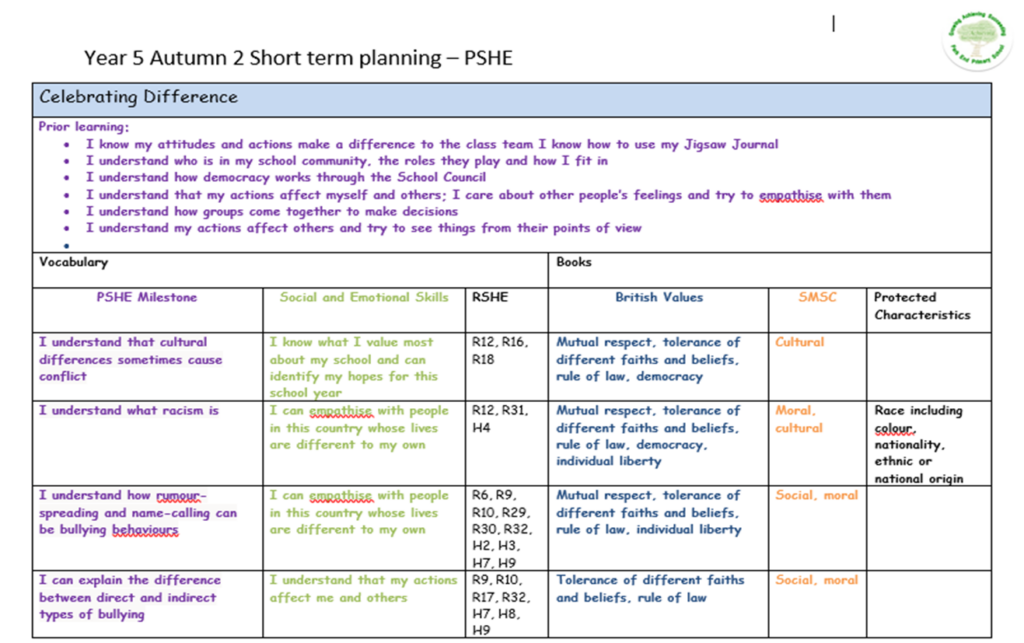
British Value Year Overviews
Acorns and Nursery
| Acorns and Nursery | |
| Democracy | Rule of Law |
| Children are involved in choices for book selectionChildren are involved in choices for song selection | Introduction to school expectations and routines |
| Individual Liberty | Mutual Respect and Tolerance |
| Start to recognise feelings and how they impact on the choices the children make Know their own likes and dislikesRecognise that we are all uniqueSupported to make choices about activities in nursery· Attitudes towards gender stereotypes – children have choices and care is taken that these are not based on traditional gender roles – e.g. dress up choices, activity choices | Identify similarities and differences between their peers and themselvesUnderstand people have different religions and cultures Learn how to respect the nursery and home environmentLearn to work co-operatively with othersCurriculum built around the prime areas of learning to support the early development of social and communication skillsDifferent cultural events such as Chinese New Year to help children understand and respect differences. |
Reception
| Reception | |
| Democracy | Rule of Law |
| Children are involved in choices for looking after role-play areasChildren decide on who is going to look after each role-play area | Use of the school’s Golden Ladder reward system. Pupils are rewarded for following rules. |
| Individual Liberty | Mutual Respect and Tolerance |
| Share favourite interests and recognise that these can be differentTalk about their own family, customs and celebrations and recognise that they might be different | Develop skills of friendship and co-operationBook choices made to ensure regular discussions on characters’ relationships and wide range of identities, beliefs and cultures Curriculum built around the prime areas of learning to support the development of social and communication skills Different cultural events such as Diwali to help children understand and respect differences. |
Year 1 and 2
| Year 1 and 2 | |
| Democracy | Rule of Law |
| Learn about ‘ opinion’ and ‘ fairness’Titanic – 1st class an 3rd class rules | Use of the school’s Golden Ladder reward system. Pupils are rewarded for following rules.Understand why we have classroom rulesHow new health and safety guidelines were put in place following the Great Fire of London and why this is still important today.Consider the rules for playing games and why following these rules is important |
| Individual Liberty | Mutual Respect and Tolerance |
| Recognises differences between people and appreciate the positive aspects of these differencesLook at the concept of individual liberty regarding animals – zoos v the wildRecognise that everyone is entitled to their own opinion Children to know people live in different set ups and they have the right to live as they please, within the rule of law.Understand that while we are free to make our choices children will learn that choices they make can affect the environmentPersonal choices regarding food choices and impact on own health and also on farming/environment | Learning about some of the key British institutions in their capital city through ‘Great Fire of London’ unit Recognise what is fair/unfair, kind/unkind and how kindness can be expressedHow to demonstrate responsibilityHow to give and receive positive feedback Respect for animalsRecognise the importance of respecting people’s different opinions |
Year 3 and 4
| Year 3 and 4 | |
| Democracy | Rule of Law |
| PSHE – the story of Martin Luther KingVoting for School Council (Rotakids)History – Roman leaders Ancient Egypt – the voting system | Visit from the local policeMilkfluencers – antisocial behaviour workshopsGolden Rules – class reward systemFire safety assemblyRules/consequences and why different ages sometimes have different rulesRules and laws in Ancient Egypt/Early British civilizations and compare to modern British societyPedestrian Training – road safety |
| Individual Liberty | Mutual Respect and Tolerance |
| Body positivity assemble and workshopsKnow that there are many different types of families in modern Britain – understand adoption, fostering and same sex relationships –‘When Tango makes Three’ storyStories in PSHE – Malala Yousafzai | Strategies to resolve simple conflict situationsUsing respectful language and considering others’ points of view Consider the diversity of people living in the UKLook at why some people have prejudiced views and why this isLook at how people in early civilizations held different beliefs and how they practised their religion and compare to todayRE -Judaism, Christianity, Hinduism, Islam and HumanistsBig kids RE – Christianity Visit from a Paralympian Stories in PSHE – Malala YousafzaiConsider all the ways people can be different (including differences of race, ethnicity, gender, religion, customs) and how we respect those differences |
Year 5 and 6
| Year 5 and 6 | |
| Democracy | Rule of Law |
| Learn how modern democracy originated in Ancient GreeceDemocracy in Britain – electionsDemocracy in Britain – how laws are madeDemocracy v Dictatorship through WW2 unitDemocratic vote for School CouncilLaws linked to women and their right to vote (Suffragette movement) | Attributes of collaboration, negotiation and compromise taughtDiscriminationDiversity in the school/wider community/wider parts of UK and respecting diversityLook at beliefs of Ancient Greeks and Vikings and understand why people have had different beliefs and why it is acceptable that people believe different thingsVisit from the local policeMilkfluencers – antisocial behaviour workshopsGolden Rules – class reward systemFire safety assemblyBritish laws including regarding: the sharing of sexual images, drugs, legal age for social media accountsLaws and civil rights |
| Individual Liberty | Mutual Respect and Tolerance |
| Prejudiced base bullying: how people express their genderCompare freedom of choice in Ancient Greece to modern Britain. Specific focus on difference between men and women in Greek times and comparisons made with today.Encourage children to have belief in their own decisions when debating enquiry questions and coming up with an answer | Respectful online relationshipsPrejudice based bullyingHow to show respect through both non-verbal and verbal communicationBenefits of living in a diverse societyDebating conventionsHighlighting the importance of valuing difference, using the treatment of Jews in WW2 as a tool to illustrate its importance |
Equality & Diversity
The Equality Act 2010 combined nine separate pieces of legislation into one single Act simplifying the law and strengthening it in important ways to help tackle discrimination and inequality.
The Act introduced 9 protected characteristics;
- Age
- Disability
- Gender reassignment
- Marriage and civil partnership
- Race
- Religion and belief
- Sex
- Sexual orientation
- Pregnancy and maternity
As a school we do not prejudice and are fully inclusive and supportive of our whole learning community.
Democracy
We have a school council group called RotaKids. Rotakids members are elected by their class peers. They are responsible for making our school a better place. The election of the members reflects our British electoral system and demonstrates democracy in action. Candidates share qualities of leadership, pupils consider characteristics important for an elected representative and pupils vote in secret, using ballot boxes. Rotakids meet up regularly to discuss issues raised by different classes. Pupils across the school use their voice to share ideas and concerns with the members of school council. This forms the basis of further discussion and important decision making. Rotakids provide feedback to the whole school and they have made their presence known to the school governors. We hope through embedding pupil voice and parliament, we will create a better understanding of living in a democratic society.
Parents’ opinions are welcomed at Park End Primary through methods such as questionnaires, surveys, parents’ evenings and open days.
Rule of Law
Our pupils will encounter rules and laws throughout their entire lives. The importance of laws, whether they be those that govern the class, the school, the community, or the country, are consistently reinforced at Park End Primary.
Pupils are taught from an early age the rules of the school. These are our Golden Rules, Playground Rules and Safety Rules. Pupils are taught the value and reasons behind rules and laws, that they govern us and keep us safe.
At the beginning of a school year, pupils will partake in discussion about classroom rules and school rules. Rules of the school are often revisited throughout the year during school assemblies and through our curriculum. This helps them to understand the reasons behind rules and the consequences if they are not adhered to. Visits from authorities such as the Police and Fire Service help reinforce these messages.
Individual Liberty
Pupils are actively encouraged to make choices and work independently. We promote freedom of choice and the right to express views and beliefs, whilst being respectful to others. We ensure that we educate and provide boundaries for young pupils to make informed choices safely. In lessons, we encourage children to select tasks that will challenge them, giving them more freedom to determine their own learning. We offer a range of clubs which pupils have the freedom to choose from, based on their interests. Through our E-Safety, we educate children on their rights and personal freedoms as well as supporting them in recognising how to exercise these freedoms safely.
Mutual Respect
Respect is one of the core values of our school and underpins our work every day, starting with self-respect and covering respect for family, friends, other groups, the world and its people and the environment. The pupils know and understand that showing respect to everyone, whatever differences we may have, is an expectation. Through our curriculum and assemblies, we ensure that pupils understand the importance of mutual respect.
Tolerance of those of different faiths and beliefs
Park End Primary is a school which is not culturally diverse. Promoting diversity is therefore central to gaining knowledge and understanding of different faiths and religions. Through R.E, PSHE, SMSC and our weekly assemblies, we strive to teach and demonstrate tolerance of other faiths and beliefs. We celebrate cultural differences across a range of subjects. The children visit places of worship that are important to different faiths. Members of different faiths and religions are encouraged to visit the school to enrich and extend understanding.
The British Legion
This year the children at Park End Primary were extremely lucky to have been chosen by the Royal British Legion to take part in an interview discussing the concept of ‘service and remembrance.’
Remembrance honours those that have served and defended our freedom and way of life and those that continue to do so. At Park End Primary, we ensure our children understand about British Values and that these values underpin the teaching across the curriculum.